
Trump’s USDA Moves to Eliminate Crucial Roadless Rule Protections From National Forests

By Curtis Johnson

On August 20th, Trump’s United States Department of Agriculture (USDA) officially proposed eliminating the national Roadless Rule. If finalized, this repeal would strip protections from 44.7 million acres of wild intact forest. The rule, passed in 2001, protects in total 58 million acres of forest from road building, logging, fossil fuel extraction and other development. Idaho and Colorado have their own state roadless rules so this proposal exempts them, at least for now.

The roadless area forests contain old-growth trees of immense grandeur, pristine rivers that are filled in the summer and fall with some of the last healthy salmon runs in the country, and trails through some of the U.S.’s grandest scenic beauty. These forests help protect some of the country’s most wondrous remaining wild species-grizzly bears, wolverines, and endangered lynx. They host key migration corridors for antelope, elk and mule deer. They protect headwaters of streams providing clean drinking water to 24 million people in the country.

The current protections include 9.3 million acres of the magnificent Tongass rainforest in Alaska. The Tongass contains  incredible landscapes- rugged ocean coastlines, glacial fjords, snow-capped peaks, wild rivers, and old-growth forest. Concentrated in the Tongass are Earth’s largest remaining intact stands of coastal temperate rainforest , making it a vital carbon sink combatting climate change. Its trees capture 44% of all the carbon stored by U.S. national forests, absorbing 1.5 times more carbon than the U.S. emits annually. Opening the Tongass and all roadless forests to destruction would be an unacceptable crime against nature.

And further opening the Tongass to development would be yet another crime of this system against native peoples. The Tongass is the ancestral homeland of the Tlingit and Haida indigenous peoples. A joint statement from the tribes condemns the decision to rescind the rule saying it was taken “without any prior consultation with our Tribe or other Southeast Alaska tribes. As a sovereign tribal nation, we do not recognize the validity of federal actions impacting our traditional homelands when undertaken without meaningful government-to-government consultation, as required by law and respect for our inherent sovereignty”.

The statement continues, “The Tongass is more than an ecosystem-it is our home. It is the foundation of our identify, our culture, and our way of life.”.

The  recission is “the largest evisceration of public lands protection in American history” according to Randi Spivak, public lands policy director of the Center for Biological Diversity (CBD). In an interview, Spivak told me the Roadless Rule shelters “hundreds of threatened and endangered species. It provides incredible recreation opportunities-hunting, fishing, hiking. These were really the last of the forests outside of wilderness that had not been opened up to industrial development.”

The USDA, which oversees the U.S. Forest Service, initially gave the public only 30 days to comment on the plan.. But they were forced after public pressure to allow 15 additional days, until Oct. 6th. Opponents are aiming to mobilize 1 million public comments as well as holding public events speaking out against the repeal .

120 environmental, conservation, and citizen’s groups have been joined by tribes, sportsmen,  wildland firefighters, and businesses dedicated to tourism, in speaking out against this decision. A letter in support of the Roadless Rule and opposing recission has been signed by 164 Congressional representatives.   

Examining the USDA Plan

The USDA proposal claims its intent is to “reduce regulatory burden and return decisionmaking for the management of inventoried roadless area to the land management planning process at the individual national forest level.” It says “Recission of the national-level prohibitions provides responsible officials with flexibility to better guide management of the National Forest System lands and respond to changing local resource conditions.”

Describing these relatively untouched forests rich with species, habitat and natural wonders as “resources” is a dead giveaway to the proposal’s actual intent.

Despite claims to “return decisionmaking” to local forest officials, the proposal quickly pivots to who these officials and their management of these “resources” would be directed by. Namely, the federal government under Trump and his executive orders to cut so-called “burdensome” regulations –(ie.-environmental and safety protections), expand timber extraction, “unleashing” energy production,  and  maximizing resource extraction in Alaska. These are all measures to allow plowing roads into and decimating formerly protected public lands to expand logging, mining, oil and gas drilling, and other capitalist development.

The forest service has already been gutted  by Trump and restructured to more thoroughly service resource extraction vs. forest protection.  Spivak told me, “Whatever Forest Service staff is left, because they have fired so many people, they are under tremendous pressure to kick out the board feet”  of timber. Further, forest management plans in local areas the proposal says will now manage these forests are already often too weak, and can be changed at a moment’s notice under an administration that Spivak points out is  “stripping all of those safety valves away.”

Right now the CBD is in court fighting a separate proposal by the Department of the Interior (DOI)  to redefine “harm” to endangered species.  Spivak continued, “So if you are a spotted owl or marbled murrelet or any wildlife creature that depends on forest canopy and older forests, their new definition under the Endangered Species Act would make bulldozing their habitat legal.” The DOI is doing this when scientific studies have clearly demonstrated that habitat loss is the primary cause of species extinction.  

USDA’s Own Draft Environmental Impact Statement Reveals Folly of their Plan

Along with its new proposed rule, the USDA is required to release a Draft Environmental Impact Statement (DEIS)  to elucidate the potential impacts of the change. An examination of the DEIS by the Center for Western Priorities stunningly reveals it undermines many of the arguments USDA gives in favor of the proposal and demonstrates the vast environmental damage the proposal would cause.

 Among other things the DEIS found repealing the Roadless Rule “would increase soil erosion, landslide risk, and sediment pollution in watersheds that supply drinking water to roughly 24 million Americans”. It also would expose “Old-growth forest that has been off-limits for 25 years to new logging”, and open the door to new oil, gas and coal leasing on currently protected lands. The DEIS states the new rule would  be “ ‘likely to adversely affect’ 327 threatened and endangered species and 71 designated critical habitats”.

It also admits money from timber sales “would [not] be sufficient to cover the costs of constructing and maintaining all new roads related to a project”. National forests already contain 370,000 miles of roads, enough to circle the globe 15 times. And The Forest Service can’t maintain even these existing roads to the tune of billions of dollars, not to mention any new roads.  

The Ruse of “Combatting Wildfire Risk”

The USDA’s rule proposal and Trump’s executive orders on logging expansion have claimed repealing the roadless rule and further logging under the guise of “forest management” are required to address “increasing wildfire risk”. Yet they obscure the overwhelming evidence that more intense wildfires are being driven primarily by the temperature increases and drought brought on by climate change. And they attempt to cover up that their plans, along with the regime’s moves to expand fossil fuel production while eliminating efforts to combat climate change, will only expand dangerous wildfire.

 The DEIS itself further undermines the claim the move is about combatting wildfire risk by admitting more roadbuilding in forests could mean more human-caused wildfire ignitions. This fits with recent scientific studies. The National Interagency Fire Center says as of 2023, the “10 year average of human-caused fires account for 88 percent of all wildfires nationally”.  These fires result from a multitude of human causes- arson, debris burning, smoking, fireworks, equipment and vehicle use, etc.  In fact, new research shows that fires are 4 times more likely to start near a road than in roadless areas. Environment America has found that “fewer than 1% of wildfires in the lower 48 state-and none of the costliest fires-since 2010 have started in roadless areas” 

FUSEE, Firefighters United for Safety, Ethics and Ecology- an organization of active, former or retired wildland firefighters are also speaking out against the repeal. They say in a statement  that more roads and human access will mean more human-caused wildfire starts. And that logging roads in backcountry areas are dangerous for attempting to stop wildfire. FUSEE argues this is best done by aviation-based tactics and other means fully allowed by the existing rule.

A current member of an active Wildfire module Molly Maguire stated, “Wildland fires are necessary and incredibly significant ecological processes. Roadless areas lack much infrastructure or human structures, so they offer opportunities to safely, economically, and ecologically manage fire across large areas without threatening human assets,”

Kate Groetzinger of the Center for Western Priorities who I interviewed, said the DEIS findings about wildfire risk made it clear to her eliminating the roadless rule, “is really about supporting the timber industry and potentially other types of infrastructure in our forests… it’s not about wildfire risk at all.” She added, “I think that there’s plenty of room for speculation about what other type of infrastructure the administration would like to put into our forests … anything from transmission lines to fiber optic cables, data centers.”

The Pushback

The USDA first announced they were considering eliminating roadless rule protections in June 2025.   Over 600,000 public comments poured in during the restricted period USDA allowed of only 21 days. 99% of them opposed the repeal. Still the administration is barreling ahead, despite their claim to consider the opinions of the public in their decision.

While Trump’s USDA claims the rule is being pushed through to return authority to local management, they clearly have no interest in hearing from the people. In 2001 when the rule was adopted, 600 public hearings were held and 108 days given for the public to comment. But with this decision the Trump regime has not held a single public hearing and cut the comment period to 30 days.

Further the government’s decision has been made without respect for tribal sovereignty, especially regarding the Tongass.  The USDA has only agreed to get “input” from tribes, not consult government to government as required by law. And they haven’t held a single hearing with affected tribes since the decision has been made. They have instead set up “subsistence hearings” in Alaska in late September that occur after the comment period is already over, and fall far short of full consultation with Alaskan tribes. The Draft Environmental Impact Statement from USDA itself also admits that consulted tribes overwhelmingly oppose the repeal.

If the USDA proposal is finalized, both Randi Spivak of the CBD and Tim Preso, managing attorney of the Biodiversity Defense Program at Earthjustice told me their organizations will launch lawsuits to prevent this repeal from moving forward if the repeal is finalized.  

 Preso said, “we’ve been defending the Roadless Rule against misguided attacks on it for 25 years and we’re not about to stop now… this administration has taken a wrecking ball to environmental protections that have been in place for decades and that really have been the reason why we have the environmental quality that we do have today. And now this administration is tearing them down one by one.”

Randi Spivak called for people to “move into action. People need to weigh in and write comments… Make it personal…. when we collectively can say 1 million people or 2 million people weighed in, and we can take that to our elected officials and say enough is enough.”

Kate Groetzinger of the Center for Western Priorities said in a statement “Despite all these negative implications and immense public opposition, the Trump administration seems to be dead set on moving forward with these rules. Western communities must rise up and oppose this change as loudly and forcefully as possible during this month-long comment period.”

Saving the Roadless Rule, and Rising Up Against Trump’s War on Nature

The move to wipe out roadless area protections may be the biggest and latest assault by the regime on public lands, but it’s also part of a larger picture, a relentless many-sided war on nature conducted for capitalist development. And it’s taking place and substantially pushing forward  the existential climate and biodiversity  crises confronting us globally.

Randi Spivak told me of countless projects she’s working on where a lot is being lost. For instance Trump’s stripping of three million acres of land from the Bears Ears and Grand Staircase Escalante National Monuments this summer.

These areas are sacred ancestral homelands of five sovereign indigenous nations in the Southwest. Days after ripping away these lands the Bureau of Land Management removed tribal seals at Bears Ears that signified the joint management and stewarding of the lands between tribal nations and the U.S. government at entry locations. Then they tore down signs at both monuments. Mining companies began filing claims  on these formerly protected lands rich in native heritage, stories, foods, cultural sites, and spiritual connection within days of Trump’s announcement, despite the law requiring a 60-day waiting period.

Beyond the heartbreaking project losses accumulating, there is the continual erosion of what Spivak termed the “rule book for disclosing harms”, through things like weakening the National Environmental Policy Act, and gutting public comment periods. “So these are all gates you go through… that’s the other level”, she said.   

She said, “I think they’re doing tremendous harm to life on Earth… they have complete and utter disregard for what they’re destroying. Because all they care about is a for-profit company’s bottom line, and where they see quote ‘burdensome regulations’ to everybody else, and especially our public lands that we, the public own, those to us are protective measures.”
It is indeed time for all of us to wake up, speak out and stand up, to defend these precious areas and lands from destruction and for our collective future.

Submit a public comment on the Roadless Rule here.

Trump’s War on Forests

republished from truthout.org

Trump’s Order to Expand Logging Threatens to Increase Climate-Fueled Wildfires

The president’s push to expand timber and fossil fuel production “is a double whammy on the climate.”

By Curtis Johnson , Truthout

Published May 17, 2025

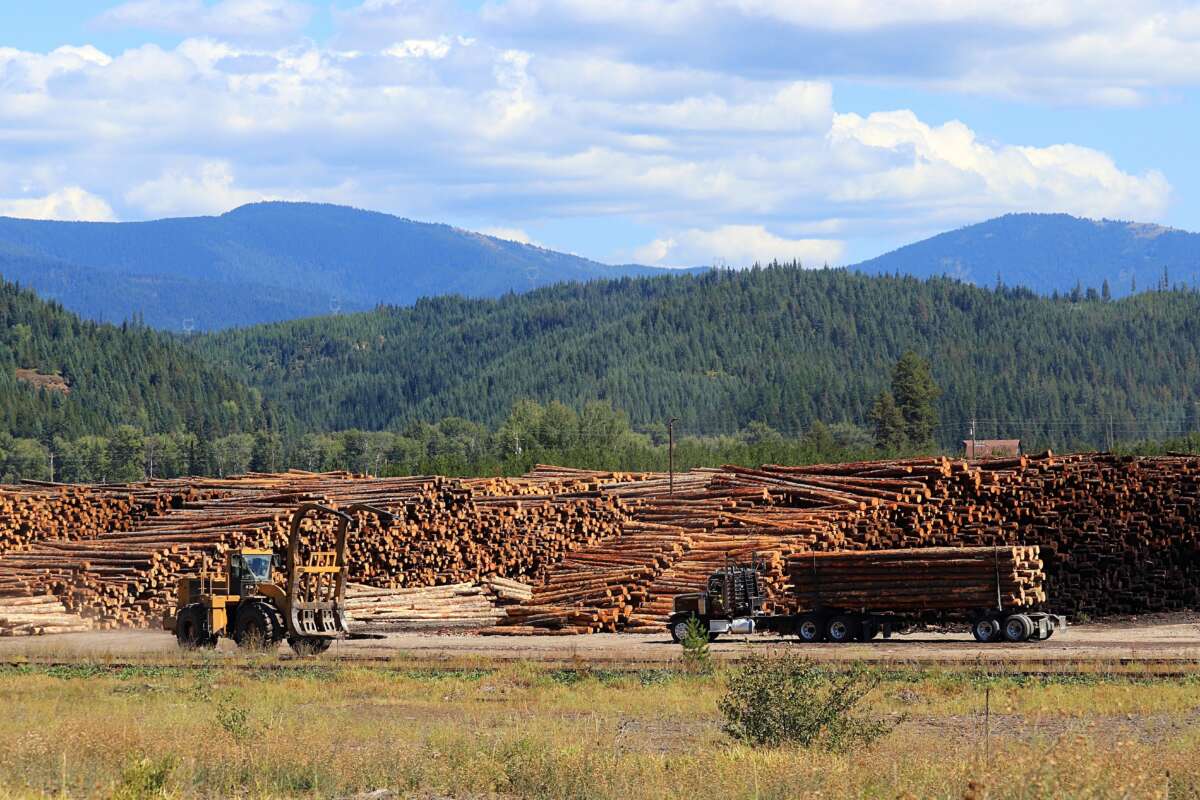
Workers add freshly harvested logs to the piles in a timber company log yard near Clarkia, Idaho.

On March 1, President Donald Trump signed an executive order titled “Immediate Expansion of American Timber Production.” The order claimed “onerous Federal policies” have hindered domestic timber production and that expanding logging was a matter of protecting “national and economic security.” It ordered the secretary of the Interior and head of the U.S. Department of Agriculture (USDA), who oversee the Bureau of Land Management (BLM) and the U.S. Forest Service (USFS) respectively, to develop a plan to expand timber targets and streamline permitting “to suspend, revise, or rescind all existing regulations, orders, guidance documents, policies, settlements, consent orders, and other agency actions that impose an undue burden on timber production.”

The responsible departments and agencies were instructed to find categorical exclusions to the National Environmental Policy Act and use “emergency regulations” to circumvent the Endangered Species Act (ESA).

After Trump’s order, the United States Fish and Wildlife Service continued the assault on endangered species by proposing a new rule that would redefine “harm” under the ESA to only include directly killing species, replacing the current definition that includes destruction of a species’ habitat. Habitat destruction is the greatest source of species extinction.

In April, USDA head Brooke Rollins directed the stripping of forest protections on more than half of all national forests and called for expanding timber production by 25 percent to address a “wildfire emergency,” and restore forest “resources.” A report from the Associated Press says the directive “exempts affected forests from an objection process that allows outside groups, tribes and local governments to challenge logging proposals at the administrative level before they are finalized.”

A map of forests Rollins has targeted includes all national forests in Washington State and California, and large sections throughout the west and other parts of the country. It even includes some wilderness areas. These forests contain some of the most cherished old-growth and mature forest ecosystems remaining in the U.S.

Related Story

In the Pacific Northwest, millions of acres of older and mature forests and old-growth dependent species like the northern spotted owl were finally protected by the Northwest Forest Plan (NWFP) in the 1990s after a century of logging that had reduced the forest to about a fourth of its historical extent. The NWFP happened as a result of intense forest defense and protest by Earth First! and many other environmental groups, studies by forest ecologists and court injunctions. The idea that these forests of immense trees, stunning natural beauty, rich biodiversity and crucial reserves of carbon sequestration could now, once again, be opened to logging is stomach-turning.

In late April, Idaho Gov. Brad Little issued his own executive order in line with Trump’s, aiming to ramp up logging with the same “rationale” as the Trump order, combatting increased wildfire danger. The order appears to replace federal responsibility for forest management in that of the state.

Jeff Juel, forest policy director for Friends of the Clearwater (FOC) said, “The state of Idaho has not earned the trust of the American public to manage forests while preserving old growth, assuring wildlife populations are robust and healthy, or maintaining hunting and fishing opportunities.… They are, on the other hand, experts at clearcutting and making state lands resemble a war zone.”

Climate Change and Wildfire

Trump’s order called for “forest management and wildfire risk reduction projects” to “save American lives and communities.” Yet none of the administration’s orders even gave lip service to the overwhelming preponderance of evidence that climate change is the main driver of more severe wildfire that has resulted in the destruction of whole communities in the west in recent years, including parts of Los Angeles.

Dominick DellaSala, chief scientist with Wild Heritage, whose stated mission is to protect and restore forests and safeguard biocultural diversity around the world, told Truthout that Trump’s policies are “a double whammy on the climate. By beginning the process of withdrawing from the Paris climate agreement, they’re going to continue to drill for fossil fuels and increase our emissions to the atmosphere. At the same time, they’re talking about an executive order that would increase logging on 280 million acres of forests across the U.S., bypassing the nation’s … landmark environmental laws, even the Endangered Species Act.”

DellaSala led an international team of scientists in doing the first nationwide mapping of mature and old-growth forests in the U.S. Their analysis found these forests sequester 9 percent of the nation’s total emissions.

“These big, fast-moving fires are the combination of extreme fire weather caused by anthropogenic climate change interacting with heavily logged landscapes. So it’s that double whammy again, by doing more logging and contributing to more emissions, you have a feedback on fire weather over the long run, that’s what’s really driving these big fires,” DellaSala told Truthout. “The latest climate attribute models are showing now that we can explain a lot of the causality around these big fires because of the increase in spring and summertime temperatures, especially heat domes, high winds and extreme droughts.”

As the Trump administration cited wildfire mitigation as a reason to increase logging to “save communities” from wildfire, it was busy axing programs, agencies and employees who were researching or seeking ways to combat the climate crisis driving increased wildfire. Trump also declared an “energy emergency” justifying elimination of government environmental regulations on energy production.

Wildfire Science and “Mitigation”

A growing body of knowledge in fire ecology understands wildfire is a natural phenomenon that ecosystems have evolved in relation to. Trees and plants have evolved strategies for flourishing with fire — such as conifers which have serotinous cones that require fire to open them so seeds are distributed.

Fire plays a key role in ecosystem restoration. It is increasingly understood among fire ecologists that a century of fire suppression in the U.S. has failed, and has been damaging in preventing fire from playing its role in maintaining forest health.

Traditionally, Indigenous cultures in the U.S. burned the landscape to control larger, more dangerous wildfires and to generate better growing conditions for native plants they harvested. Cultural burning is credited by most scientists as well as tribes with helping maintain healthy forest ecosystems and biodiversity.

A member of the Karuk tribe in California told CalMatters “Fire, for us, is not just a tool — it’s a lifeline, a means of renewal, and a vital part of our culture.” Indigenous burning was suppressed in California and in the U.S. as a whole in the 19th century by the government as part of destruction of Native culture, theft of land and genocide.

Wildland fire is a very complex phenomenon. Different types of forests have very different fire regimes. Degrees of fire intensity differ greatly between forests and even within forests of the same general type, depending on rainfall, climate, and other factors. Historically, fire intensity varied, even within forest patches.

Decades of fire suppression by the USFS has led to a buildup of denser forests in some western dry forests. In the era of climate crisis, this has contributed to more intense and widespread fires. There is basic agreement among scientists on the role of climate change as a prime driver that must be addressed. Many agree on the need to curtail fire suppression in the backcountry to help restore the natural function of fire on the landscape. Steps here include allowing certain backcountry fires to burn and to increase prescribed burning, especially during seasons of lower fire risk.

There’s also a clear need to develop programs for home hardening, vegetation clearing near structures and better escape plans for threatened communities.

But the science on using mechanical thinning of forests to manage wildfire is not settled. There is ongoing debate about how effective it is at lowering the severity of wildfire or its threat to communities. Disagreements remain over the degree and type of thinning that should occur, where and when it should be done if at all, if it should only be undertaken in tandem with prescribed burning and whether it is beneficial or harmful to the ecosystem.

Scientists do in general agree that if done, thinning should focus on dry forests, removing smaller trees and protecting more fire-resilient older and mature trees. A USFS study showed that older forests that have been protected from logging to preserve nesting area for the northern spotted owl under the NWFP can act as “fire refugia,” burning at lower intensity than surrounding landscape. A 2016 study in Ecosphere showed forests with high levels of protection from logging in dry and mixed-conifer forests burn with lower intensity than unprotected forests or those subjected to logging, even though they generally contain more forest biomass.

Forest Service Fuel Treatment

No matter the scientific debate, the reality is that over recent decades, government policy has largely continued to rely on fire suppression. This strategy has failed to lower the risks to communities or to save forested ecosystems. At the same time, the USFS has, in recent years, begun to use thinning and prescribed burning on hundreds of thousands of acres of land each year and has plans for tens of millions more.

Environmental groups that are watching this on the ground say some mitigation projects have been done more judiciously and can be helpful, but now a great deal of USFS projects are just clear-cutting of forests to produce revenue for timber companies.

Karen Coulter of Blue Mountains Biodiversity Project (BMBP), which works to protect and restore the ecosystems of the Blue Mountains and Eastern Oregon Cascades, told Truthout she has been monitoring public lands in eastern Oregon and southwest Washington for 33 years. She said in the 1990s, average timber sales were smaller-scale, legitimate commercial thinning. “Sometimes I could agree with it. Because it was thinning from below, and it wasn’t hacking down the large trees and so forth. It was more reasonable. Now it’s virtual clear-cutting, much more intense logging, and it’s on a landscape scale.”

BMBP’s website has many photos of USFS projects termed “free selection,” “commercial” thinning or “understory removal” in the Malheur and Umatilla National Forests that are essentially clear-cuts. Everything is mowed down. Some of these include old-growth trees.

Right now, the organization is contesting a USFS project in an Inventoried Roadless Area, (public lands without roads that have high conservation value), that includes Walla Walla, Washington’s, municipal watershed and old-growth trees. They say logging here could cause damage to water quality for the city and streams that support threatened salmon, steelhead and bull trout.

Nick Cady is the legal director with Cascadia Wildlands (CW) in Eugene, Oregon. CW works to defend and restore wild ecosystems in the Pacific Northwest. Cady told Truthout that another issue is often Forest Service proposals are turned over to timber companies to execute, giving them leeway. Meanwhile, he said the BLM is “just logging as much as they can.”

Cady said of USFS “mitigation” proposals, “If you log to maximize value, you dramatically increase fire risk. That is what the data on the ground has shown time and time again…. So if you say you’re going to maximize logging to improve fire, it’s just not real.”

USFS did not respond to a request for comment in time for publication.

In Montana, the Alliance For The Wild Rockies recently sued and stopped a USFS project planning to cut and burn 15,000-45,000 acres covering the whole eastern side of the Bitterroot National Forest over 20 years, claiming “categorical exclusions” from protecting threatened species.

The amount of timber sold from logging USFS lands in the U.S. from 2014 to 2023 has varied between 2.8 and 3.2 billion board feet a year. Expanding timber production by 25 percent would increase sales to 3.75 billion board feet a year from its current 2024 level of around 3 billion board feet.

Internal USFS documents obtained by WildEarth Guardians (WEG) show top officials under both Trump and former President Joe Biden have pressured foresters to streamline the process for timber sales. At a June 2017 meeting, the USFS leadership team for the Pacific Northwest said the head of USFS was calling to “increase our restoration activities” so as to “increase acres treated and volume output as a consequence.”

USFS has also been undertaking plans to revamp the NWFP in ways that would increase the cut of older trees. One proposal would, among other things, change the age of trees protected in wet forest Late Successional Reserves from 80 to 120 years, opening up 824,000 acres to logging. WEG says this would “eviscerate the entire concept of [the reserves] which were originally intended to provide large blocks of older forests for species like the northern spotted owl.”

What’s Next?

The Trump regime now threatens to worsen the devastation of some of our most important older forests, gutting the most fire-resilient ecosystems, increasing the threat of climate change and more dangerous wildfire. It does so while slashing environmental protections across the board and gutting key agencies and programs that offer some protection to humans and the planet.

Cady and Coulter both told Truthout that the regime is going to run into all kinds of problems with accomplishing their plan — shuttered lumber mills, previous legal decisions against timber interests in court and real difficulties with the process of designing these sales after firing thousands of forest service employees.

Cady said Cascadia Wildlands has “a massive body of supporters” that can be mobilized to act regardless of decisions in the courts. He said, “People live here, they don’t want massive amounts of logging.”

In cooperation with court challenges and active public engagement by these and other groups, forest defense efforts including active tree sits have increasingly jumped off in Pacific Northwest forests recently. These include two tree sits in southern Oregon on BLM land, one of which helped precipitate a court ruling canceling logging in the Poor Windy Project in May 2024. Another tree sit has just begun to protect legacy forest on Department of Natural Resource land in Washington State near the Elwha River on the Olympic Peninsula.

Coulter said what Trump’s order is attempting “would be illegal and challenged in court, but the problem is their strategy seems to be that they could wrench these destructive timber sales through first before there’s any final legal outcome. And this is kind of what they’re doing, is wrecking everything as fast as they can, dismantling the agencies,” she said. “We need to raise the profile of the forest defense movement…. We need to raise the profile of forests, along with everything else that they’re targeting.”

.

Destruction in LA–Capitalism’s Perfect Firestorm

By Curtis Johnson

1.17.25

The Palisades and Eaton fires in LA have killled 25 people. Tens of thousands have been forced to evacuate. Thirty people are still listed as missing. The fires are not fully contained, and dangerous conditions sparking further fires continue to persist as of now.

Thousands of people have seen their homes and often all of their most precious keepsakes destroyed. Some have lost friends, relatives and neighbors. Places of small business have been completely burned to the ground.   As of this writing, 12,000 homes, businesses and other structures have been destroyed, mainly in the communities of Pacific Palisades and Altadena.  Photos of these communities show the scale of destruction, with block after block laid to waste.

Pacific Palisades is a mixture of wealthy and middle class residents, including a number of Hollywood celebrities, some of whom have seen their homes destroyed. Altadena is a working and middle class community of mixed nationality and a center of a vibrant Black community. Black people moving from the south to this area during the Great Migration were often prevented through redlining of moving into many parts of LA, but were after a time able to settle in Altadena. Now whole areas of this community have been devastated. The Black community here and more broadly has been coming together to provide aid, determined to rebuild.

Fascist MAGA Lies and the Deeper System Responsible.

Added to  the suffering of thousands from the fire’s destruction as well as from days of smoke which is toxic (as I pointed out in an 2017 piece in Truthout)  the fascist MAGA-ites led by Trump are taking advantage of the suffering to blame immigrants, lesbian fire officials they claim are hired “through DEI policies”, etc. Perched like vultures on the verge now of full power, they are spreading lies that the problem is California officials diverting firefighting resources and water to programs for immigrants and to save the Delta smelt, a small endangered fish in the San Fransisco Bay Delta region.  

The lies continue despite fire officials pointing out that they and no other municipal fire force in existence could have stopped the speed and explosiveness of this fire (which while true points up a big problem for the future). One example of this is that traditional fire policy calls for three fire engines for a single house fire, but here there were thousands upon thousands of structure fires, do the math. Of course Trump et al offer no evidence of any of their claims, just more stuff they have made up, and a number of articles have pointed out the lies in these allegations.

MAGA republicans are now trying to bludgeon California officials by threatening to withhold federal aid unless they further submit to advancing Trump’s hateful anti-immigrant, white supremacist fascist program.

The truth of the matter is there are actual deeper reasons these fires and others like them all over the planet are increasing and levels of harm exploding, which we’ll explore below. And these are reasons that the fascists in particular want to divert attention from.

At the heart of this is global climate change and the increasing heating and drought it causes which sucks vegetation and soils dry, predisposing them to burn. Climate change is largely fueled by the capitalist countries of the world, and largely those in the developed world, continuing to burn fossil fuels. They continue to do this because of how highly profitable fossil fuel exploitation is, and because in the intense competition between various powers, control over fossil fuel resources play a key role in who will come out on top. Global carbon emissions continue to rise, despite the clear crisis this has created or the claims to be addressing the problem.

In combination with climate change, there are a myriad of other ways capitalism functions  that are to blame. This, includes continuing destruction of wildlands and endless development that negates natural limits and increases the number and spread of wildfires.( Wildfires are of course a natural phenomena, but are now taking place at an unprecedented scale.) Further reasons lie with the system’s inability to adequately prepare for or take account or really fully plan for such natural disasters, at least in the way the situation really demands.

All these reasons are driven by capitalism, a system that can only function by turning things needed by humans into commodities to be sold for profit. A system that is driven by competition between various interests and entities to maximize profitability in competition with others and therefore makes decisions and allots resources based on profitability and in the interests of continuing that pattern of functioning. A system that is anarchic and unable to plan development and growth, or control or limit it, based on long terms needs of people or ecosystems.

Because of this embedded pattern of functioning, capitalism is driven by it’s own dynamics to put profitability over human lives and ecosystems. In it’s functioning, capitalism and capitalist enterprises view nature and its bounty as simply a free gift to be extracted for maximum profitability instead of something to be cherished and protected.  

 Both Democrats and Republicans represent the interests of capitalism. The phenomena leading to such disasters as the fires in LA will only become more destructive under a fascist, white supremacist Trumpian rule, that claims in lunatic fashion that climate change which is already catastrophic, is a hoax. Trump promises to “drill baby drill”, removing even minor limitations Dems have put in place, which have done nothing to truly address the climate crisis. Remember during the election how Biden and Harris “countered” Trump’s attacks on drilling by pointing out that under their administration the U.S. has become the largest producer of oil and natural gas on the planet? Which is true. Or how Harris “countered” Trump in Pennsylvania by saying, no she doesn’t oppose, but supports the destructive practice of fracking?

Let’s look deeper at what is taking place in LA.

What Fueled the Fire’s Explosiveness

The Eaton and Palisades fires in LA both started in hills above LA in what is often called the “wildland-urban interface”, where homes and development have spread into formerly wild areas. Such building has been allowed to spread under pressure from developers despite the danger of sparking wildfires that this type of development poses, particularly in drought prone areas like LA. The Center for Biological Diversity (CBD) warned how this pattern of development is heightening the danger of destruction to human communities and wildlife and altering the natural ecology  in a paper written in 2021 “Built to Burn”

The CBD also pointed out how the California State Assembly passed legislation in May of 2024   that would have opened the way for even more development in the state’s high risk fire hazard zones and allowed developers to skirt fire hardening rules for buildings and other fire reduction measures. Fortunately, this bill died in the California Senate but shows the pressure capitalist developers continue to try to exert, despite the danger.

The LA fires spread extremely quickly because of powerful Santa Ana winds, at times in gusts of hurricane strength. The winds spread the fire not mainly by pushing them along the ground, but by sending chunks of burning embers miles into neighboring communities, setting them alight. Embers from incinerated buildings were then blown by the winds throughout. The Santa Anas are a normal occurring phenomena this time of year, but what made them so destructive was their strength in combination with other extreme fire conditions, including a delay in winter rains.

Earth.org calls the conditions fueling the LA fires a “lethal combination of high temperatures and very low humidity, dry vegetation, and strong offshore Santa Ana winds” allowing the fires “to grow and spread much faster than they could be contained.” Very fast fires of this type cause the burning of 75% of the structures burnt in the US from 2001 to 2020.

 Meterologist Eric Holthaus says the conditions in LA match what the National Weather Service calls “extremely critical fire weather…sustained winds greater than 30 mph, relative humidity of less than 10% in the presence of drought conditions and temperatures warmer than 70 degrees. This is the first time in history these criteria have been met anywhere in the United States during the month of January.”  LA county experienced the hottest summer in 130 years this year and has had virtually no measureable rain since May 2024. At the outbreak of the fires the humidity in the air was reportedly about 2%.  

Historically, California and the Southwest U.S. more broadly have suffered periodic droughts, sometimes lasting even decades (see The West Without Water by B. Lynn Ingram). But recent droughts have been the most extreme in recorded history. A scientific paper titled “Indicators of Climate Change in California” shows that investigators using tree-ring data back to the year 800 found the southwest region of the U.S. “determined 2000-2021 to be the driest 22-year period in the region” over the last 1200 years.

And this is not simply due to natural causes. Other scientific work cited in the paper showed about 19 percent of the dryness in 2021 and 42 percent in 2000-2021, were attributable to human-caused climate change. This work also pointed out that “Climate change will continue to make dry and warm years happen more often and drought conditions will worsen” (for scientific sources see link).

The link between climate change and increased wildfires is very well established. A report from the National Oceanic and Atmospheric Association (NOAA) titled “Wildfire climate connection” says, “Climate change, including increased heat, extended drought, and a thirsty atmosphere, has been a key driver in increasing the risk and extent of wildfires in the western United States during the last two decades.” Studies cited there demonstrate that climate change has been the “main driver of the increase in fire weather in the west” and a key factor in the doubling of wildfires in the west between 1984 and 2015.  

Climate in Southern California is shaped by many factors, including swings in the Pacific Decadal Oscillation ,( a natural phenomena of shifts between warm and cool phases in the Pacific every 20–30 years) and in the El Nino, La Nina climate cycles, which may bring much more rain or less. The years 2022 and 2023 were El Nino years that brought heavier rain to southern California and even more snowpack to the Sierra Nevada mountains. The Sierra Nevada have in general suffered from low snowpack during drought years and more rain relative to snow due to climate change. The heavier rain in the LA region during 2022 and 23 caused enhanced vegetation growth. That vegetation then dried to tinder this past very dry year, providing even more fuel for fires in LA.

Fire experts interviewed by the LA times say the LA fires are symptomatic of the return of largescale urban fires, thought until recently to be a thing of a bygone era-such as the Great Chicago Fire of 1871. But urban fires have hit California, especially since the 1990s, and more recently “devastated Gatlinburg, Tennesee in 2016, the towns of Superior and Louisville in Colorado in 2021 and Lahaina, Hawaii”, two years ago. The town of Paradise and nearby communities in northern California were wiped out by a wildfire in 2018 killing 85 people and destroying 50,000 structures. The Camp fire that destroyed Paradise was sparked by a badly maintained  Pacific Gas and Electric transmission line.

The immediate origins of the LA fires are not proven yet, though residents near the origin of the Eaton fire recorded video of fires breaking out near electrical transmission lines owned by California Edison and some are now suing Cal-Ed.

As the fires continue and people try to overcome the destruction and losses they’ve suffered, people all over have poured in money to aid in their recovery. In a refutation to the hateful BS spread by Trump and MAGA to try to ramp up support for his vicious plans to deport millions of immigrants and despite their fears of ICE roundups, day laborers in LA have come together to take up support efforts for victims of the Altadena fires. This is truly an example we can learn from, to stand together and support immigrants and others who will be coming under increased attack, and to refuse to accept a fascist America.

The certifiable lunatic Alex Jones tweeted on X that the LA fires were the result of a globalist conspiracy to wage economic warfare on and deindustrialize the great USA. To this, Elon Musk, the richest, and arguably one of the most obscene individuals on the planet responded “True”. Are these the people we will accept  to be dictating over our lives and our planet?